
Species profile · Exotic Rodents
African pygmy mouse
Mus minutoides
One of the smallest rodents, the African pygmy mouse weighs only a few grams. It belongs to the African pygmy-mouse group within Mus, the same genus as the house mouse, but has its own distinctive ecology and life history.
- Classification
- Rodentia · Muridae
- Native range
- Sub-Saharan Africa
- Habitat
- Grassland, scrub and other cover
- Activity
- Dusk and night
- Wild diet
- Small seeds and insects
- Lifestyle
- Ground-dwelling · social
In the wild
Natural history
Distribution & habitat
African pygmy mice occur in sub-Saharan Africa, using grassland, shrubby vegetation and other habitats with protective cover. They occur in both lowland and upland environments.
Behaviour & activity
They move through the grass layer and use runs and sheltered nesting places. Family groups and shared nests are reported, with most activity around dusk and after dark.
Diet & foraging
Small seeds and insects are important foods. Foraging in dense cover allows these tiny animals to exploit food resources while remaining less exposed.
Life cycle & reproduction
Gestation is around nineteen to twenty-one days. Young are born poorly developed and are reared in nests; published breeding studies describe rapid development during the first few weeks of life.
02 · At Exotic Rodentry
Within our collection
Collection notes updated: 4 November 2026
These notes describe our own animals and experience. Feeding details record our current practice and are not a complete care guide.
We first kept African pygmy mice in 2008 and have kept and bred them on and off since then. Their tiny size and energetic behaviour make them fascinating animals to observe.
First kept: 2008
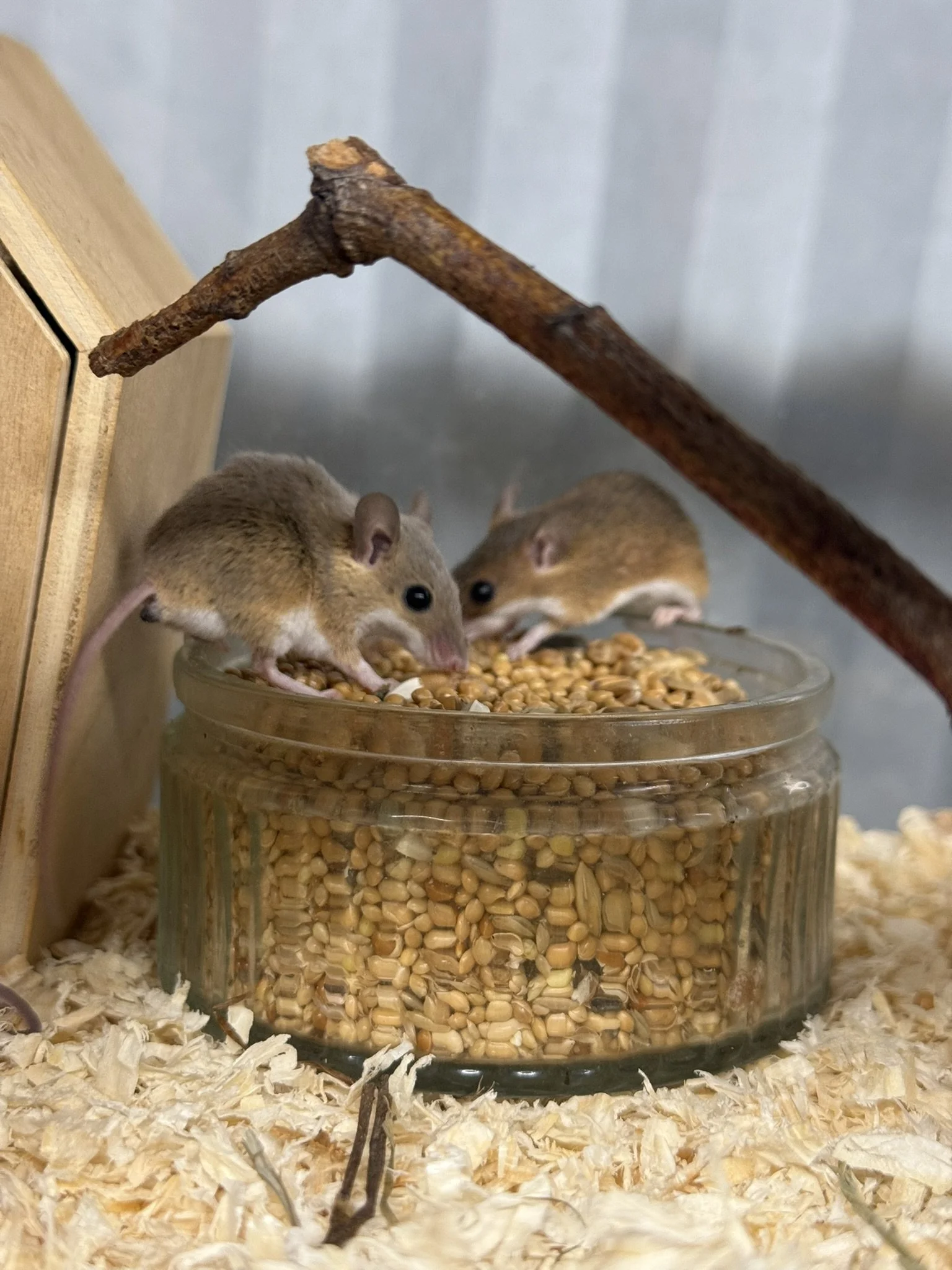
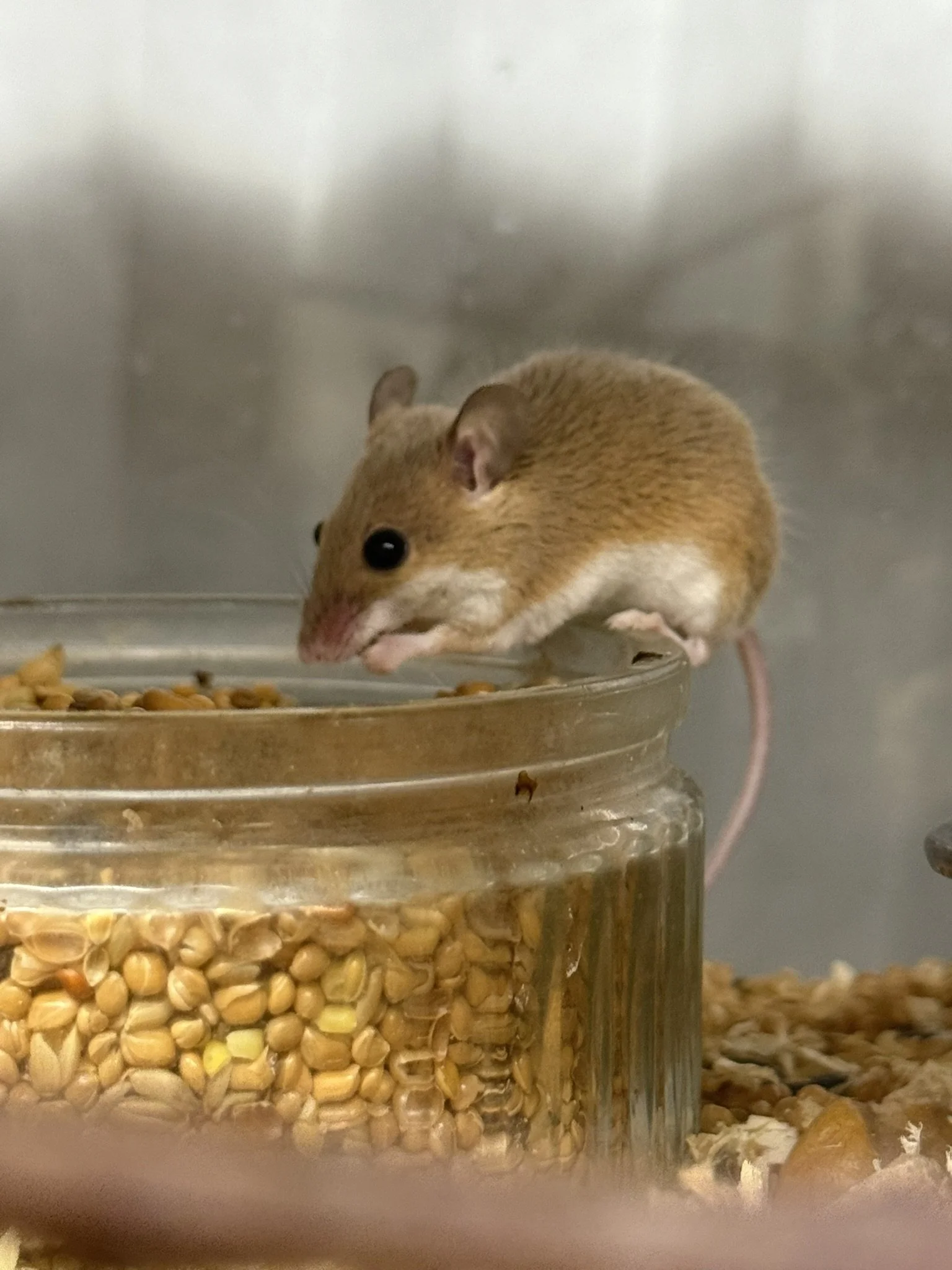
Current animals: Two groups: one mixed group of blue and brown mice, and one brown group; numbers and ages vary
Collection history
Our present groups began with two pairs obtained through an animal exchange in 2024. We have exchanged further animals with other collections when opportunities arose to broaden the breeding stock. Over the years our groups have ranged from a trio to more than fifty animals. We have a particular fondness for the brown form, although we have also kept animals described by keepers as blue.
Housing & enrichment
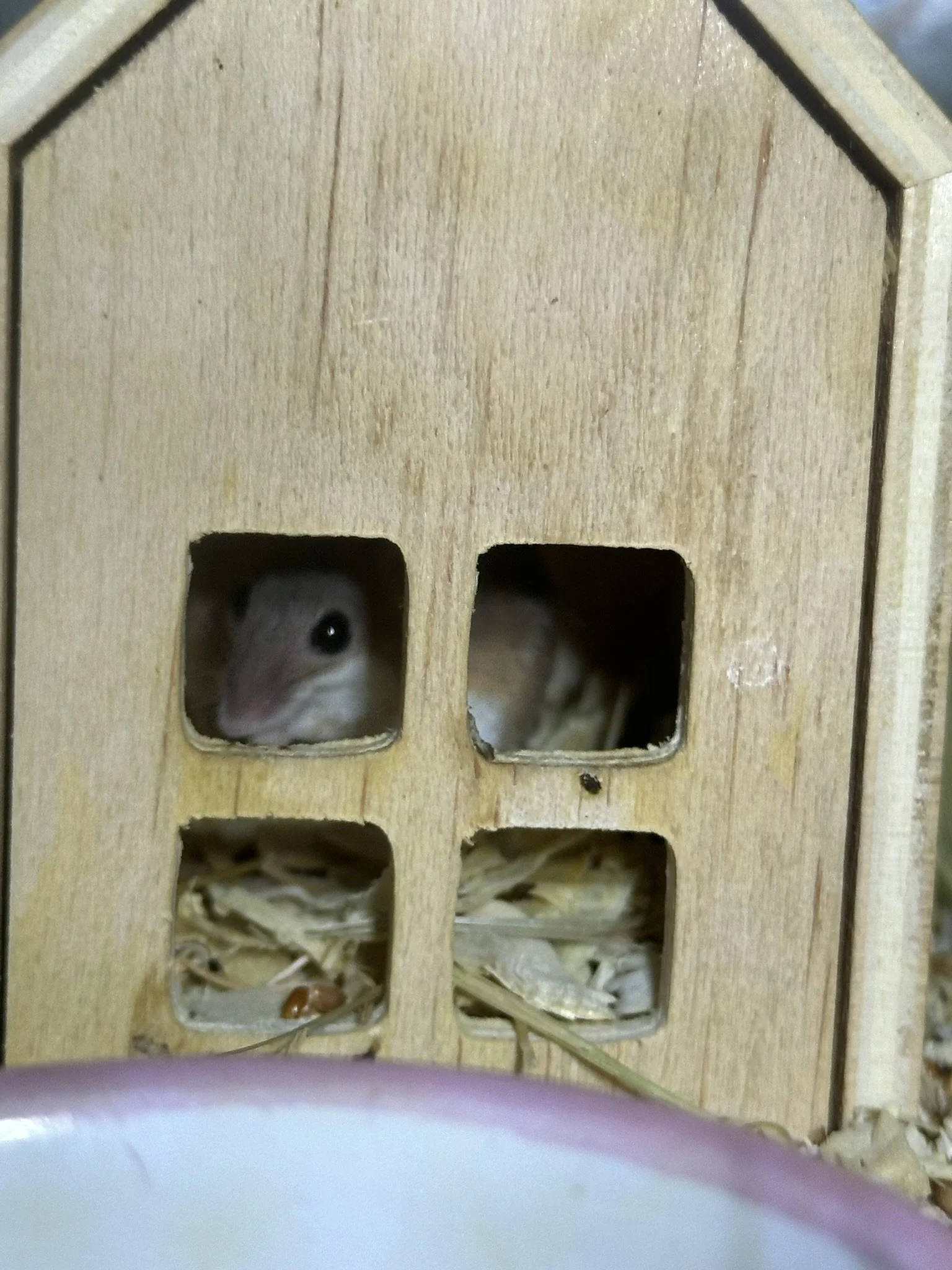
We use secure, chew-resistant glass tanks with ventilation openings small enough to prevent escape while allowing adequate airflow. Deep substrate, numerous hides and branches offer opportunities to dig, shelter and climb. Fresh water is provided in a shallow dish or bottle. They often nest beneath furnishings, and live insects give them something to search for and chase. We also provide small stones as part of the enclosure furnishings.
Feeding in our collection
Small seed mixes, including foreign finch, budgie and parakeet mixes, form a regular part of our feeding routine. Millet sprays and freshly gathered seeding grasses are particular favourites. Our mice often select the smaller seeds even when sunflower seeds are available. They also take live and dried invertebrates, together with suitable soft fruit and vegetables. Their enthusiasm for hunting insects is striking for animals of this size.
Behaviour & handling
These are animals we mainly enjoy watching. They are exceptionally quick and agile and can jump surprisingly high. In our collection, established single-sex and mixed-sex groups have lived together successfully, particularly when they have grown as family groups. Introductions to established groups have had mixed results, so compatibility cannot be assumed. Catching them for checks takes care and patience, and they may bite when restrained.
Breeding experience
Several females within a group have produced regular litters, and we have maintained some groups for years from small starting numbers. We have noticed breeding slow or litters fail to be reared as numbers increase. We treat this as a reason to review space, resources and group composition, rather than relying on it to control population size.
Future plans
We intend to maintain the current groups, place surplus animals appropriately and continue exchanging animals to broaden genetic diversity. We would also like to add more brown animals to strengthen that breeding group.
From our collection
Collection photographs
Sources & further reading
- Paignton Zoo — African pygmy mouse
- Tiergarten Schönbrunn — Mus minutoides
- Willan & Meester — Breeding biology and postnatal development
- Viljoen and colleagues — Nocturnal activity and diet background
Natural history reviewed: 2 November 2026. Collection notes updated: 4 November 2026. Photographs added: 4 November 2026.