
Species profile · Exotic Rodents
Lesser bamboo rat
Cannomys badius
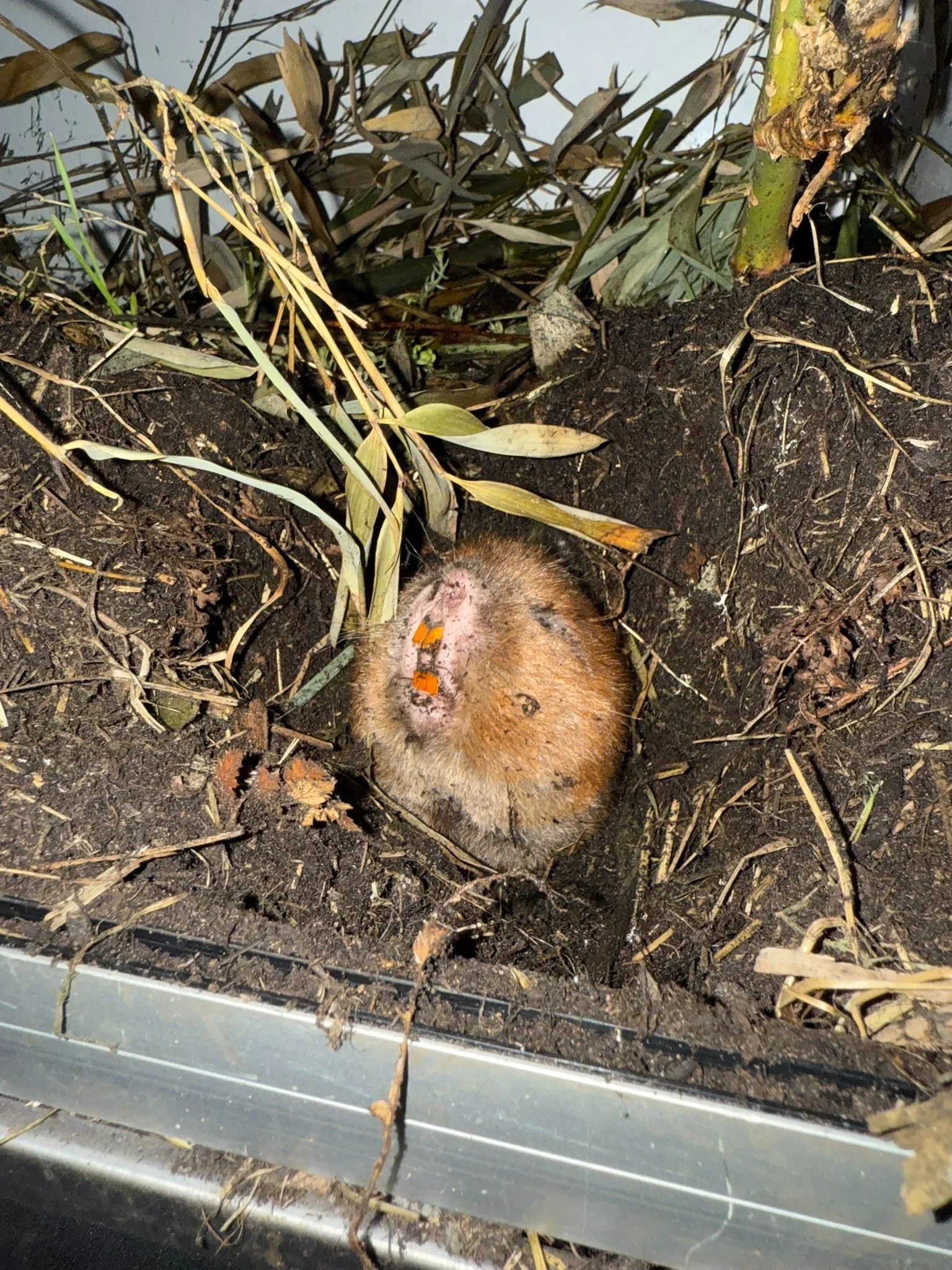
A compact, powerful burrower, the lesser bamboo rat is adapted to a life largely below ground. Small eyes and ears, strong limbs and prominent incisors suit an animal that digs through soil and feeds on tough vegetation.

- Classification
- Rodentia · Spalacidae
- Native range
- South and Southeast Asia
- Habitat
- Bamboo thickets and woodland
- Activity
- Often evening and early morning
- Wild diet
- Roots, shoots and other plants
- Lifestyle
- Fossorial · underground
In the wild
Natural history
Distribution & habitat
Its range extends from the Himalayan region into parts of southern China and mainland Southeast Asia. Bamboo thickets, wooded hills and grassy areas provide food and suitable digging ground.
Behaviour & activity
Both the claws and incisors help excavate tunnels. Burrows include a nesting chamber, while above-ground foraging is commonly associated with the evening.
Diet & foraging
Bamboo roots and shoots feature prominently in the diet, but other roots, grasses, seeds and fruit are also eaten. The common name does not imply an exclusively bamboo diet.
Life cycle & reproduction
Published accounts describe litters of one to five young and a gestation of around six to seven weeks. Breeding is often associated with wet-season conditions.
At Exotic Rodentry · Notes updated October 2026
Within our collection
Collection notes updated: 23 October 2026
These notes describe our own animals and experience. Feeding details record our current practice and are not a complete care guide.
We have kept lesser bamboo rats since 2018. Their distinctive behaviour, individual personalities and the challenge of breeding them continue to fascinate us.
Our animals & their history
The collection currently holds one male and one female. The female was sourced in the UK, while the male originally came from the EU.
We began with a trio. One of the original females remains, now alongside a newer male. Maintaining and breeding this unusual species has involved setbacks as well as some very rewarding relationships with individual animals.
Housing & enrichment
We use a secure, metal-framed enclosure with sliding glass doors and a deep, layered substrate of topsoil, coir, leaf litter, sand and other organic material. Ceramic shelters provide durable retreats, while wooden furnishings are expected to be chewed.
Digging and nest-building are central to the enclosure. Leaves, branches, decaying wood and bamboo provide material to carry, manipulate and gnaw. Scatter feeding encourages foraging, and both animals store substantial quantities of food in their underground chambers.
Feeding in our collection
Our feeding routine includes a range of fresh vegetables, particularly roots and other substantial plant foods, alongside rodent pellets and mixed dry foods. Fruit is offered occasionally in small amounts. Bamboo and other suitable browse also provide opportunities to gnaw.
Individual character
Getting to know these animals has been a highlight. Both now hand-feed and may wake when they hear us working nearby, apparently expecting something to eat. Our female is particularly expressive and will sometimes “shout” when we stop scratching behind her ears.
The current male was initially difficult to handle, but became much more comfortable with regular interaction. Earning their trust and seeing them choose to approach, accept a stroke or take food from our hand has been deeply rewarding. The male has also attended events as an ambassador for his species.
Social management: a hard lesson
In our experience, apparently peaceful cohabitation has not guaranteed lasting compatibility. One original pair had shared space for at least six months before the smaller female attacked the male, fatally. The female was herself lost suddenly several months later.
We have also seen a male and female share a nest for a time, then return to separate sleeping areas following conflict. These experiences have made us cautious about interpreting nest-sharing as a permanent bond, and about how long breeding introductions should last.
Breeding experience
We have not yet successfully reared a litter. We have tried introductions of different lengths, including short periods of up to 48 hours and longer periods together. On two occasions we observed mating, followed by marked weight gain, nest-building and a later loss of weight around the expected time of birth.
Those observations suggested possible pregnancy, but no young were seen, so we cannot confirm either pregnancy or birth. Understanding what happened, and improving the outcome of future attempts, remains an ongoing challenge.
Looking ahead
Our aim for late 2026 is to acquire further animals in preparation for breeding work in 2027. Depending on availability and numbers, we would also like to work with other collections to help maintain the species in the UK.
A closer look
Collection photographs
Sources & further reading
Natural history reviewed: 23 October 2026. Collection notes updated: 23 October 2026.